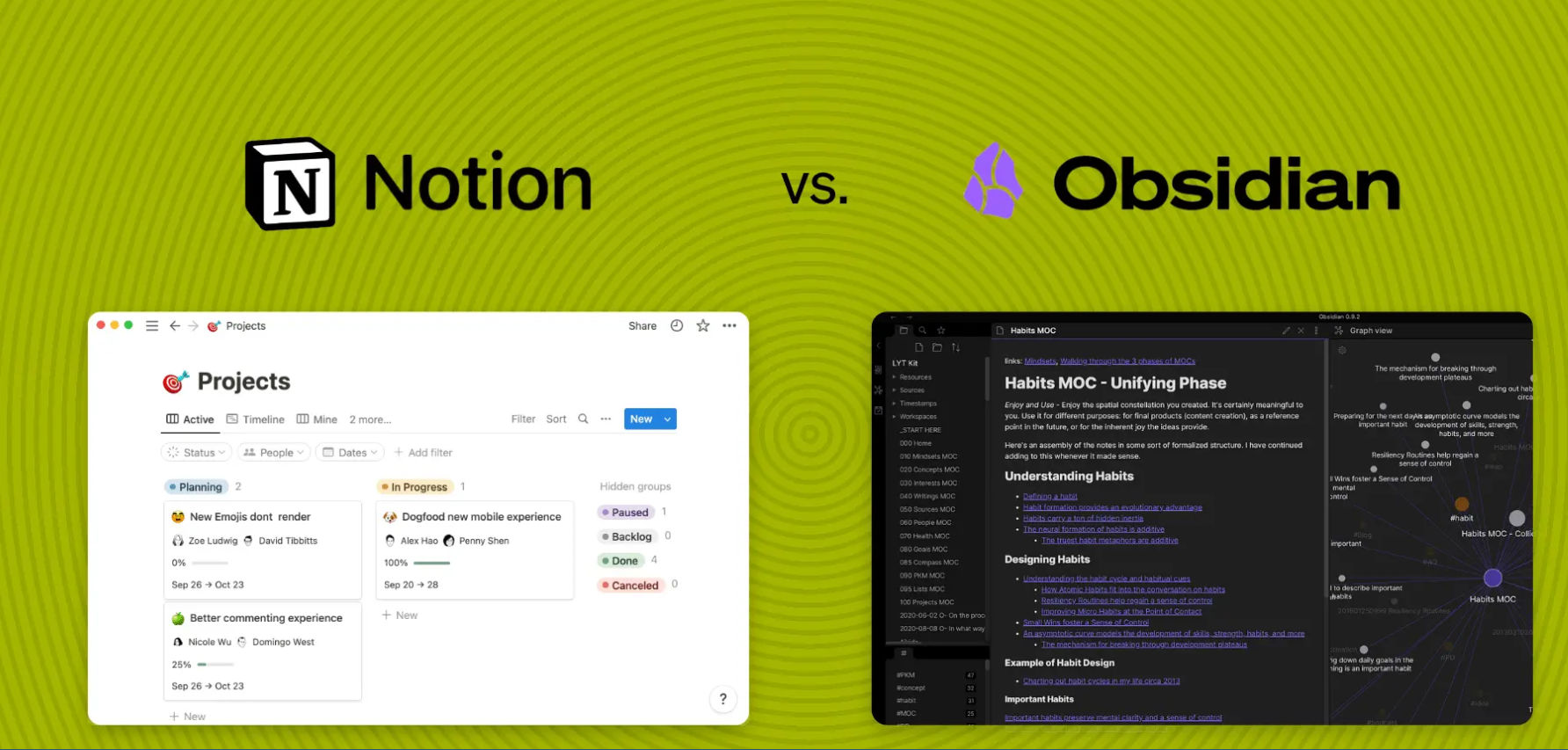
The personal knowledge management (PKM) landscape has grown tremendously over the past few years, with individuals and organizations increasingly relying on digital tools to organize ideas, manage projects, and capture information effectively. Among the many options available, Notion and Obsidian have emerged as two of the most popular platforms. Although both tools aim to help users manage knowledge efficiently, they are built around fundamentally different philosophies and cater to different types of users.
Notion has established itself as a versatile, cloud-based workspace designed for productivity and collaboration. Its block-based architecture allows users to create documents, databases, project boards, wikis, and task management systems within a single platform. This flexibility makes Notion particularly attractive to teams, businesses, students, and professionals who need an all-in-one solution. Whether you're planning projects, documenting processes, or managing personal goals, Notion provides a polished and intuitive environment that can adapt to a wide variety of use cases.
One of Notion's greatest strengths is its collaborative capabilities. Team members can work together in real time, leave comments, assign tasks, and share knowledge seamlessly across departments. The platform also offers numerous templates that simplify setup and improve productivity. Furthermore, Notion's free plan is generous enough for individual users, while its paid plans provide excellent value for teams seeking a centralized workspace without significant costs.
Obsidian, on the other hand, takes a completely different approach by emphasizing privacy, ownership, and long-term accessibility. Rather than storing your notes exclusively in the cloud, Obsidian saves them as plain Markdown files directly on your device. This local-first philosophy gives users complete control over their data while ensuring that their notes remain accessible even without an internet connection. For users who prioritize privacy and independence from proprietary platforms, this approach offers considerable peace of mind.
Another feature that sets Obsidian apart is its powerful knowledge-linking system. Through bi-directional links and its distinctive graph view, users can visualize relationships between ideas and uncover connections that might otherwise go unnoticed. This capability makes Obsidian particularly appealing to researchers, writers, developers, and lifelong learners who deal with large amounts of interconnected information. Additionally, the platform boasts a thriving community with over a thousand plugins that extend its functionality, covering everything from daily journaling and task management to spaced repetition and advanced note organization.
Choosing between Notion and Obsidian ultimately depends on your priorities and workflow preferences. If collaboration, cloud synchronization, and a visually appealing interface are your top priorities, Notion is likely the better choice. However, if you value data ownership, offline access, privacy, and the ability to build a deeply interconnected knowledge base, Obsidian stands out as the superior option.
In reality, there is no universally "best" tool. Both platforms excel in their respective areas and continue to evolve rapidly. Many productivity enthusiasts even choose to use both—leveraging Notion for project management and collaboration while relying on Obsidian for personal knowledge management and long-term note-taking. By understanding your specific needs and working style, you can select the platform that best supports your productivity and knowledge management goals.